Wisconsin Supreme Court Election
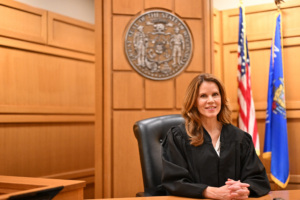
Judge Chris Taylor will defend the rights of Wisconsin residents – her opponent wants to take them away
The Wisconsin Supreme Court’s flip to a liberal majority has resulted in a political landscape that better aligns with the will of the people. In 2026, Wisconsin voters have the opportunity to shore up the pro-people majority on the court by choosing a candidate who has spent her career advocating for reproductive rights and representing the people in the state assembly — a true movement lawyer.
State courts decide over 95% of all cases in the United States and have the last word on dozens of issues that impact the lives of people living in every state. These courts play a critical role in protecting our democracy and fundamental rights, so it’s crucial that the judges who sit on these benches will protect the rights of the people, not just the wealthy and powerful. Judges who are empowered to make these decisions must possess the lived experience to understand how their decisions will impact people’s lives, and it’s up to us to ensure these judges will protect and defend our rights.
-
After winning control of the governor’s office and the state assembly in 2010, Wisconsin’s Republican lawmakers drew legislative district maps that would cement their power in the legislature for the next ten years. They went on to gut protections for public and private sector unions, cut tax rates for the wealthiest Wisconsinites, slash funding for public services and infrastructure, expand charter schools and private school vouchers while eliminating hundreds of millions in funding for the state’s public universities, ban most abortions after 20 weeks, and implement one of the strictest voter ID laws in the United States.
Even when Democrats regained power of the state’s executive branch in 2018, Republicans kept their supermajority in the assembly. They also passed a law that stripped the executive branch of many of its powers just before Democrats were set to take office. Following the 2020 census, Republican lawmakers drew maps that once again gerrymandered the state’s legislative districts to essentially ensure Democrats could never take control of either chamber, then turned to the courts to order the maps into effect. The Wisconsin Supreme Court ultimately sided with Republicans in April 2022, allowing gerrymandered maps to take effect for a second 10-year redistricting cycle. In July of that year, the court ruled that absentee ballot drop boxes, which had enabled hundreds of thousands of Wisconsin voters to avoid mail delays and exposure to COVID-19 while voting in the 2020 elections, were illegal.
When the U.S. Supreme Court overturned Roe v. Wade in June 2022, Wisconsin Republicans asserted that an abortion ban that had been on the books in Wisconsin since 1849, which made terminating a pregnancy in the state a felony, was enforceable once again. Providers in Wisconsin stopped providing abortion care after several county prosecutors threatened to file charges against them. The pause on services continued until September 2023, when a judge ruled that the statute was only applicable to violent crimes against a pregnant person that caused the loss of her pregnancy, rather than to medical services sought by a pregnant person. The ruling allowed services to resume, but the issue continued to be litigated in the courts.
Though it seemed Republicans could never lose their stranglehold over the state government no matter how unpopular their agenda, everything changed in 2023 when a Republican justice on the Wisconsin Supreme Court retired at the end of her term and created an open race. On April 4, 2023, Milwaukee County Circuit Court Judge Janet Protasiewicz, who came under fire during the campaign for stating her belief that abortion is a fundamental right and for calling the legislative district maps rigged and unfair, defeated her opponent by an 11-point margin. When Justice Protasiewicz was sworn in that August, the court’s partisan composition flipped to four progressives and three conservatives, giving progressives a majority on the court for the first time in more than 15 years.
By December of that year, the court had struck down the state’s legislative maps as unconstitutionally gerrymandered and ordered new maps to be drawn for the 2024 elections in which every member of the legislature was required to run under the new, fairer maps. In July 2024, the court reversed the 2022 opinion that banned ballot drop boxes, holding that nothing in Wisconsin law prevents election administrators from offering drop boxes as a ballot return method at their discretion. Voter turnout in the 2024 November elections was as much as 64% higher than in previous election cycles, suggesting that voters saw elections under the newly drawn maps as more competitive and worth engaging in than under the previous gerrymandered maps. Since the 2024 elections, the partisan makeup of the state legislature more accurately represents the partisan makeup of this historically purple state’s electorate.
Another seat on the court came up on the ballot in 2025, and voters elected Dane County Circuit Court Judge Susan Crawford by more than 10 points. In addition to holding several positions as an attorney in the state government, Crawford represented progressive clients in high-profile cases, including Planned Parenthood of Wisconsin, the League of Women Voters, and the Madison teachers’ union, before she became a judge. That summer, the court ruled the 1849 abortion ban had been rendered obsolete by the state’s other abortion-related legislation developed in the 50 years since the U.S. Supreme Court’s ruling in Roe v. Wade.
Wisconsin voters’ decision to elect a progressive Wisconsin Supreme Court majority has tangible real-world implications. Current legal challenges that will likely end up before the court in the coming months or years include a challenge to the 2011 law that gutted public and private employee union protections, a challenge arguing the state’s school funding system fails to provide a sound basic education in violation of the state constitution, two challenges to the state’s congressional maps that are currently being considered by three-judge panels appointed by the Wisconsin Supreme Court, and ongoing litigation impacting abortion access in Wisconsin.
The Wisconsin Supreme Court’s flip to a liberal majority has resulted in a political landscape that more closely reflects the will of the people after voters consistently chose supreme court candidates who are outspoken about their progressive beliefs. Now, with the impending retirement of a conservative incumbent justice in 2026, progressives have the opportunity to expand their majority on the Wisconsin Supreme Court with Wisconsin Court of Appeals Judge Chris Taylor, who is running for the open seat on the court.
-
Chris Taylor
Wisconsin Court of Appeals Judge Chris Taylor has always understood the importance of social justice to building a safe and just society for everyone. Raised in a union household where she saw firsthand the importance of women having the freedom to earn fair wages and make decisions about their own bodies and families, she began her career working in private practice from 1996 to 2002, primarily practicing family and plaintiff-side employment law. She then worked as the legal and policy director for Planned Parenthood of Wisconsin from 2002 to 2011. She was elected to the Wisconsin Assembly in 2011 and served there until 2020. In 2020, she was appointed to the Dane County Circuit Court by Gov. Tony Evers (D) in 2020 and elected to a full term on the court in April 2021. She was elected unopposed to the Wisconsin Court of Appeals in 2023.
Taylor served as the legal and policy director for Planned Parenthood of Wisconsin for nearly a decade, where she advocated for the rights of Wisconsinites to obtain abortion, contraception, and family planning services. Her advocacy helped to defend and expand access to contraception, including mifepristone and emergency contraception, as well as to family planning services, including Wisconsin Medicaid’s family planning program. She was also involved in high profile litigation and advocacy surrounding the case of pharmacist Neil Noesen, who refused to fill or transfer a patient’s birth control prescription, including In the Discipline of Neil Noesen and Noesen v. Wisconsin. The controversy ultimately led to the inclusion of the Contraceptive Equity Provision in the state’s 2009 budget, which requires insurance plans that offer prescription drug coverage to cover contraceptives and requires pharmacists to fill such prescriptions. Taylor would go on to defend the law after she left Planned Parenthood to become a state legislator. During her time at Planned Parenthood, she was also a prominent advocate for the 2007 Compassionate Care for Rape Victims Act, which requires hospitals to provide access to emergency contraception to victims of sexual assault, as well as information about their rights to undergo a physical examination and report the assault to law enforcement. Taylor would also go on to defend these rights as a member of the Wisconsin Assembly.
During the nearly 10 years she spent as a member of the Wisconsin State Assembly, Taylor authored more than 250 bills and resolutions, primarily focused on civil rights, public health, criminal justice reform, and environmental protections. She authored or co-authored several important bills that eventually became law, including the Safe at Home Act, which created a residential address protection program to allow victims of sexual assault, domestic violence, stalking, and human trafficking to keep their addresses private. As of October 2025, the program had 2,744 active participants in 1,262 active Wisconsin households. She also authored a bill in 2019 that died in committee that year but that went on to provide the framework for what would eventually become the state’s Wisconsin Sexual Assault Kit Tracking System, made possible by two laws enacted in 2021 that established systems to effectively collect and submit sexual assault evidence kits and created a database that enables law enforcement, healthcare providers, and victims to track the progress of investigations in a state database.
Taylor was a fierce advocate for dozens of important progressive issues during her time in the assembly. She testified against a 2013 bill that sought to require abortion providers to have hospital admitting privileges and a 2015 bill that proposed a ban on abortions in Wisconsin after the 20th week of pregnancy. Both of these anti-abortion bills eventually became law, though the 2013 law requiring providers to have hospital admitting privileges was later struck down by a federal judge. Taylor’s other public health advocacy included a proposal that would have required schools and daycares to test children for lead and funded replacement of contaminated windows and pipes, as well as a proposed cannabis legalization and regulation scheme, which she co-authored. She also authored a set of mandates that would have required 25% of all energy generated by Wisconsin utilities to come from renewable sources by 2025 and opposed every version of a proposed Wisconsin mining bill due to her concerns about environmental and water quality impacts. She also served on the powerful Joint Finance Committee, where she advocated for increased spending on public education and defended collective bargaining rights and the rights of demonstrators to gather at the Wisconsin capitol building to protest. Because the entirety of Taylor’s time in the legislature was spent in the Democratic minority, many of the more than 250 bills she authored or co-authored never became law.
As a Wisconsin Court of Appeals judge, Judge Taylor has shown her dedication to fairness, impartiality, and a commitment to following the law. In a case brought by a group representing student voters that challenged rules about the validity of absentee ballots with incomplete information about witnesses to the casting of absentee ballots, Taylor ruled that absentee ballots whose witness information contains incomplete address information must still be counted if a municipal clerk can identify a physical location where the witness may be reached, resulting in fewer absentee ballots being rejected for technical reasons. She ruled in favor of a renewable energy nonprofit in a case that challenged a rule implemented by the Wisconsin Public Service Commission that blocked utility companies from reimbursing retail customers who lowered their energy usage during times of peak demand, holding that the commission exceeded its authority by implementing the rule, which had the effect of lowering incentives for utility companies to finance investments in clean energy infrastructure. She also ruled that a patient’s malpractice lawsuit against her gynecologist could move forward, expanding the state’s definition of a ‘treating physician’ and granting patients greater oversight and autonomy over decisions affecting their bodies. The Wisconsin Supreme Court later affirmed Judge Taylor’s ruling that allowed the lawsuit to move forward.
Taylor has received the endorsement of the Wisconsin Conservation Voters, Reproductive Freedom for All, and Planned Parenthood Advocates of Wisconsin, as well as U.S. Senator Tammy Baldwin and former U.S. Attorney General and current National Democratic Redistricting Committee chairman Eric Holder. Taylor is also endorsed by numerous Wisconsin labor unions, including the Wisconsin State AFL-CIO, the Wisconsin Laborers’ District Council, United Food and Commercial Workers Local 1473, American Federation of Teachers Local 212, American Federation of State, County, and Municipal Employees Council 32, United Steelworkers, Sheet Metal Workers Union 18, United Autoworkers Region 4, North Central States Regional Council of Carpenters, Madison Teachers, Inc., and the International Brotherhood of Electrical Workers Wisconsin State Conference. She has also been endorsed by 163 current and former Wisconsin judges, including five current and former Wisconsin Supreme Court justices, 22 current and former appeals court judges, 129 circuit court judges, and seven municipal court judges have also endorsed Taylor’s candidacy for a seat on the Wisconsin Supreme Court.
Judge Chris Taylor has spent her entire career fighting to make Wisconsinites’ lives better. During her time in the assembly, she was an outspoken supporter of abortion rights, criminal justice reform, labor, and democracy. As a judge, she has protected and expanded individual freedoms and has demonstrated her commitment to the rule of law. Wisconsinites deserve to have a justice with Judge Taylor’s experience and distinguished record of public service on its highest court.
Maria Lazar
Wisconsin Court of Appeals Judge Maria Lazar began working as an assistant attorney general after Gov. Scott Walker’s election in 2010. In April 2015, Lazar was elected without opposition to fill an open Wisconsin circuit court seat in Waukesha County, where she served rotations in the juvenile, criminal, and civil divisions and worked as a drug treatment court judge. In 2022, she was elected to a seat on the Wisconsin Court of Appeals.
Lazar has a lengthy record of supporting extreme policies that strip rights and freedoms away from Wisconsinites. As an assistant attorney general, she defended Scott Walker’s attacks on working families; defended Wisconsin abortion restrictions; defended Wisconsin’s Act 10, which gutted collective bargaining rights for public employees; and defended Republican-drawn legislative maps that disenfranchised thousands of Wisconsin voters. As a Wisconsin Court of Appeals judge, Lazar has shown a pattern of wrongly interpreting and applying Wisconsin law to further her right-wing agenda. She ruled that the Wisconsin Department of Natural Resources’ PFAS regulation was unlawful under Wisconsin’s “spills law,” severely limiting the state’s ability to protect drinking water; ruled in favor of releasing sensitive voter data to people who participated in efforts to overturn the results of the 2020 presidential election in Wisconsin; and upheld a 2018 law passed by the Republican legislature to limit the powers of the executive branch after Democrats swept elections for state offices including governor, secretary of state, and attorney general in the 2018 elections. In each of these decisions, the Wisconsin Supreme Court ultimately overruled Lazar, overturning her ruling on the DNR’s authority in a 5-2 opinion that held that the DNR does have authority to address PFAS contamination; ruling in another 5-2 opinion that Lazar had failed to follow proper court procedure in her decision to release voter data and calling her ruling a “patent violation” of precedent; and unanimously striking down her opinion that upheld the authority of Republican lawmakers to strip the powers of the state’s executive branch just before their political opponents assumed office. She has described herself as “fair, independent, and impartial”, but has made clear she will disregard procedure and precedent to advance her hardline agenda.
Lazar has courted right-wing extremists throughout her judicial career. When campaigning for her seat on the Court of Appeals in 2022, Lazar featured the support of former Wisconsin Supreme Court Justice Michael Gableman, who at that time was leading a fruitless “investigation” into claims of fraud in the 2020 presidential election that wasted more than $1 million taxpayer dollars. Gableman has since agreed to accept a three-year suspension of his law license after he faced complaints of misconduct during the probe by the Office of Lawyer Regulation. Lazar also received the endorsement of former Trump campaign attorney Jim Troupis, who is facing felony charges tied to his attempt to throw out the presidential election votes of 220,000 voters in Dane and Milwaukee counties in 2020. Wisconsin Elections Commission member Bob Spindell, who was one of Wisconsin Republicans’ 10 fraudulent electors in 2020 and who praised ads aired by the Republican Party that sought to suppress BIPOC voters in Milwaukee, also endorsed Lazar’s campaign for the Wisconsin Court of Appeals in 2022, as did Wisconsin Right to Life and Pro-Life Wisconsin.
In the lead-up to the launch of her campaign for the Wisconsin Supreme Court in the summer of 2025, Lazar participated in a panel discussion hosted by the 5Riders, a far-right so-called “patriot group,” where she criticized federal judges who have ruled that actions taken by the Trump administration were unconstitutional – and noted that some constitutional protections do not extend to all individuals. Several months later, she appeared alongside Michael Flynn, President Donald Trump’s (R) national security advisor who pleaded guilty to lying to the FBI and became one of the most fervent champions of Trump’s unfounded claims that he lost the 2020 election. She has appeared with all three groups in the Wisconsin Conservative Coalition, whose mission is to increase right-wing political influence and impose their extremist views onto Wisconsin residents. She also headlined an event in March 2026 alongside Rebecca Witherspoon, a local operative of Moms for Liberty, a far-right organization that advocates a supposedly pro-parental rights agenda by opposing vaccine and other public health requirements, LGBTQ+ and racially inclusive academic curricula, and other student inclusion efforts, and is a well-known advocate of school and public library book bans. The event was hosted by Club 47, which describes itself as an organization that promotes MAGA candidates. She has also called the overturning of Roe v. Wade “very wise” and indicated she would have disagreed with the Wisconsin Supreme Court’s 2025 ruling that the 1849 abortion ban could no longer be used to ban abortion across Wisconsin.
Maria Lazar has spent her career rolling back people’s rights, attacking reproductive health care and voting rights, and doing the bidding of powerful special interests and her billionaire friends. If elected, she would be the most extreme member of the Wisconsin Supreme Court and has suggested that she will use her seat to advance her right-wing agenda.
-
The Wisconsin Supreme Court is the last word for millions of Wisconsinites, including workers, consumers, women, students, people with disabilities and health concerns, and the most vulnerable among us. Judge Chris Taylor will protect and defend the rights of all Wisconsinites, while Maria Lazar will use her power to take these rights and freedoms away. AFJ Action Campaign recommends that Wisconsin voters choose Wisconsin Court of Appeals Judge Chris Taylor in the election for a seat on the Wisconsin Supreme Court on April 7.
Paid for by Alliance for Justice Action Campaign, www.afjactioncampaign.org, and not authorized by any candidate or candidate’s committee.