State of Justice: October 2026 Vacancies and Elections Updates
Vacancies
No state supreme court vacancies were announced this month; however, as of October 29, several state supreme court seats remain vacant after departures earlier this year.
Hawai’i
The associate justice seat vacated by Vladimir Devens’s elevation to chief justice remains open. The public comment period ended on October 5, 2026, and the Judicial Selection Commission is now considering which nominees to forward to the governor. The Judicial Selection Commission is considering twelve applicants. The commission is expected to forward four to six nominees to the governor, who will select an appointee subject to confirmation by the state Senate. Notably, Hawaiʻi has a wide selection of movement attorneys and judges seeking appointment. They are:
Karen T. Nakasone, Catherine H. Remigio, and Shirley M. Kawamura are each current sitting judges. Nakasone is the Chief Judge of the Hawaiʻi Intermediate Court of Appeals (ICA). She previously served as an ICA Associate Judge and spent nine years as a trial judge for the Oʻahu First Circuit Court. Earlier in her career, she worked for 15 years as a trial and appellate attorney for the State Office of the Public Defender. Judge Remigio is a Circuit Court Judge for the Oʻahu First Circuit Court (Criminal Division) and previously the Family Court Deputy Chief. Her past experience includes serving as a per diem District Court judge, a partner at Bryant & Remigio, LLC, a deputy public defender for nine years, and a circuit court grand jury counsel. Judge Kawamura is a Circuit Court Judge for the Oʻahu First Circuit Court (Civil/Environmental Court division). She formerly served as a District Court judge, a commercial and insurance defense litigator at Kawashima Lorusso LLP, a deputy public defender for six years, and an associate at Ashford & Wriston.
R. Brian Black and Dr. Lance D. Collins are both public interest advocates. Black is currently the President and Executive Director of the Public First Law Center (formerly the Civil Beat Law Center for the Public Interest), a non-profit dedicated to government transparency and freedom of information. He previously served as Deputy Corporation Counsel for the City and County of Honolulu and was a complex commercial litigation partner at Hogan Lovells in New York. Over half of his career has focused on aggressively litigating landmark cases before the Hawaiʻi Supreme Court to strengthen the state’s open records and Sunshine laws, dismantle government secrecy, and defend the public’s right to information. Collins is the principal attorney at his own public interest law firm, the Law Office of Lance D. Collins, and a per diem judge. Since his admission to the Hawaiʻi Bar in 2005, Collins has operated exclusively as a sole practitioner, and his firm specializes in grassroots litigation, Native Hawai’ian ancestral land rights, environmental protections, and good government transparency. Before law school, Collins earned a master’s degree in Indigenous Politics and worked extensively in grassroots community organizing.
David M. Forman is currently a law professor and Co-Director of the Environmental Law Program at the William S. Richardson School of Law. His career focuses on environmental governance, administrative law, and Native Hawai’ian rights. He previously served as executive director of the Hawai’i Appleseed Public Interest Law Center and a staff attorney for the Native Hawai’ian Legal Corporation. Finally, Benjamin E. Lowenthal is a prominent criminal defense, civil/criminal appeals, and post-conviction litigator on Maui. He spent eight years at the State Office of the Public Defender, where he rose to become the supervisor of the appeals and parole division. As of October 25, the commission had not yet forwarded its list of four to six nominees to Governor Josh Green.
New Hampshire
Chief Justice Gordon J. MacDonald resigned effective September 15, 2026, creating a vacancy on the New Hampshire Supreme Court. In New Hampshire, the judicial selection commission screens applicants, and the governor nominates a successor, subject to confirmation by a majority of the Executive Council. As of October 26, Governor Kelly Ayotte had not nominated a replacement.
South Carolina
Justice John C. Few withdrew his bid for legislative reelection on March 3, 2026, restarting the application and screening process for his seat. Few left the South Carolina Supreme Court at the end of July, when his term expired, and his seat remains vacant. As reported in September, public screening hearings were scheduled to begin November 16, with the General Assembly’s election of a successor tentatively scheduled for March 3, 2027. South Carolina’s Judicial Merit Selection Commission screens applicants before legislative election. South Carolina is one of only two states in which the legislature, rather than the governor, selects state supreme court justices.
Elections
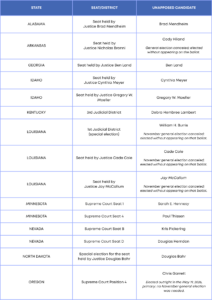
State supreme court elections give voters meaningful choices about the courts that shape their lives. In 2026, fifteen seats, including seven without an incumbent seeking re-election, went unchallenged. An uncontested race is not inherently a cause for concern: a qualified, independent, and effective judge need not face opposition simply for opposition’s sake. But when judges fail to uphold those standards, or their decisions impair our civil and human rights, voters deserve a meaningful alternative and clear information that makes the stark differences in judicial records, qualifications, and approaches visible.
Progressive policymakers, funders, and attorneys can help create those alternatives by building credible candidate pathways and supporting accessible voter education. The goal is not to challenge every incumbent, but to ensure that voters can distinguish judges who administer justice fairly and independently from those whose records undermine equal protection, due process, and other constitutional protections that the federal courts no longer uphold. Building that pipeline of talent will take sustained work across election cycles; no single election can resolve every concern. Still, investing in demographic and professional diversity, strong candidates, and informed voters offers a realistic path toward courts that better protect the rights of everyday people.
2026 State Supreme Court Elections
Without a General-Election Opponent