Michigan Supreme Court Election
What you need to know about the Michigan Supreme Court election
It’s the most important election on your ballot!
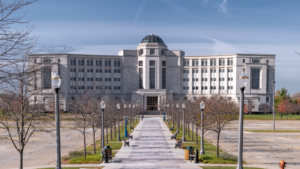
Michigan’s process for selecting supreme court justices is unique among the states. Delegates of the major political parties nominate candidates for each Michigan Supreme Court seat appearing on the ballot at their parties’ nominating conventions, which typically occur in July or August of general election years. After securing their party’s nomination, candidates go on to appear on the nonpartisan section of the general election ballot. When, as is the case this year, more than one supreme court race appears on the ballot, candidates are not required to declare which seat they are seeking to fill. Rather, voters are instructed to select the same number of candidates as there are seats appearing on the ballot, and the candidates who earn the most votes are elected. Two seats on the Michigan Supreme Court are on the ballot in the Tuesday, November 3, 2026, general election. Incumbent Justices Megan Cavanagh and Noah Hood are running alongside Casandra Morse-Bills, Michael D. Warren Jr., Thomas Howe, and Jody White.
-
Judges in Michigan’s court system make decisions that affect every Michigander. The Michigan Supreme Court is the state’s highest court, and it is the final word on how the Michigan Constitution and all the state’s laws and regulations are interpreted. The court typically hears between 70 and 80 cases each year, just 3–4% of the more than 2,000 requests for review it receives each year. The court’s rulings set binding precedent for every court in the state.
The Michigan Supreme Court has played a crucial role in defending and protecting voting rights and Michigan’s citizen initiative process as Republicans have undermined election integrity and tried to limit the ability of citizens to participate in the direct democratic process, especially in marginalized communities. The court allowed a ballot initiative to establish a citizen redistricting commission, which would strip the power to draw legislative and congressional district maps from partisan legislators, to appear on the 2018 general election ballot; Michigan voters adopted the proposal that year. In 2022, the court ruled that Republican-backed laws that placed geographic caps on signature collection requirements and strict transparency requirements for paid petition circulators were unconstitutional hurdles to the citizen initiative process. The court also ordered the Board of State Canvassers to certify two citizen-initiated proposals to expand voting access and enshrine reproductive freedoms in the state constitution. Voters adopted both proposals in that year’s election. The court declined to hear a 2023 appeal brought by two conservative political operatives who were charged with felony voter intimidation and computer crimes after they sent robocalls to Detroit voters falsely claiming their personal information would be shared with law enforcement and debt collectors if they voted absentee during the 2020 election. The pair subsequently pleaded guilty and were sentenced to probation. And in 2024, the court ruled that the legislature’s practice of adopting citizen-initiated ballot proposals only to weaken them immediately during the same legislative session violated the Michigan Constitution’s citizen initiative and direct democracy protections.
The court has also greatly expanded the protections afforded in both the U.S. and Michigan Constitutions that protect individuals against cruel and unusual punishment, especially for young and vulnerable people. In 2019, the court ruled that judges cannot rely on the conduct underlying an acquitted charge to lengthen a sentence for a separate conviction. In 2022, the court ruled that mandatory life-without-parole sentences for 18-year-olds are unconstitutional under Michigan’s ban on cruel or unusual punishment. In 2025, the court expanded this rule to include 19- and 20-year-old offenders, and expanded it again in 2026 to bar “de facto” life sentences for youthful offenders. The court ruled in 2026 that defendants can introduce expert medical testimony asserting a diminished capacity defense to contest first-degree murder charges. Beyond making Michigan’s criminal justice system fairer, the court has expanded Michiganders’ civil liberties. In 2025, the court ruled that the odor of cannabis alone is not probable cause for a warrantless vehicle search and cannot be treated as indicative of criminal activity. And this year, the court ruled that law enforcement cannot test an arrested individual’s DNA to investigate unrelated crimes and amended Michigan Court Rule 8.115 to ban federal immigration officers from conducting civil arrests inside or immediately outside state courthouses.
The Michigan Supreme Court’s rulings go beyond protecting Michiganders’ constitutional rights and ensure that individuals involved in the criminal justice system are treated with fairness and dignity. The court’s rulings have also protected consumers, drivers, homeowners, workers, and the environment in recent years. In 2020, the court ruled that municipal and county government entities that sell foreclosed homes to satisfy property tax debt must return any surplus equity to the former homeowner. In 2023, the court ruled that changes to medical fee payment caps in the state’s auto no-fault insurance law could not be applied to crash victims who were injured before the law took effect. The court expanded whistleblower protections for workers and expanded liability exposure for employers in 2025, ruling that workers could sue for wrongful termination if they were fired for refusing to engage in lawbreaking actions at their employer’s direction. And this year, the court vacated a permit for Enbridge’s proposed $800 million tunnel project beneath the Straits of Mackinac, helping preserve and protect some of Michigan’s most pristine natural resources. This year, the court also struck down two decades of precedent that had made corporations nearly universally exempt from consumer fraud lawsuits, restoring the full power of the Michigan Consumer Protection Act.
The justices of the Michigan Supreme Court make decisions that impact the lives of every Michigander. That’s why it’s so important that those justices possess the credentials, integrity, and principles befitting a seat on the state’s highest court.
-
In 2026, two incumbent justices are running for new terms on the court, so voters will be instructed to choose two from among a total of six candidates vying for the two seats appearing on ballots this November: those belonging to Chief Justice Megan Cavanagh and Justice Noah Hood. Chief Justice Cavanagh is seeking a second eight-year term on the court in 2026, and Justice Hood, who was appointed to the court in 2025 to finish out a term ending in early 2027, is running for his first full term on the court. Chief Justice Cavanagh and Justice Hood were both nominated to continue serving on the court by the Michigan Democratic Party at the party’s nominating convention, held on August 29, 2026.
Chief Justice Megan Cavanagh
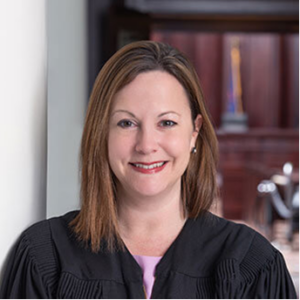
Chief Justice Megan Cavanagh has served as a justice of the Michigan Supreme Court since January 1, 2019. She is the daughter of longtime Michigan Supreme Court Justice Michael Cavanagh, who served on the court from 1983 to 2015. Her uncle, Jerome Cavanagh, was mayor of Detroit from 1962 to 1970.
She earned a B.S. in environmental engineering from the University of Michigan in 1993 and worked as an environmental risk and property development consultant for four years. She then attended Wayne State University Law School and earned a J.D. in 2000. Following graduation, she joined Garan Lucow Miller P.C., where she practiced civil appellate law for over 15 years.
She ran for a seat on the Michigan Supreme Court in 2018 and defeated Justice Kurtis Wilder, whom Gov. Rick Snyder (R) had appointed the previous year. She was chosen as the court’s chief justice in April 2025 upon the retirement of the previous chief justice, Justice Elizabeth Clement. Cavanagh is seeking a second eight-year term on the court in 2026.
Associate Justice Noah Hood
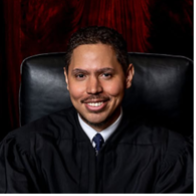
Justice Noah Hood has served on the Michigan Supreme Court since 2025. He is a lifelong Detroiter and grew up on the city’s east side. His father, Rev. Nicholas Hood III, served on the Detroit City Council from 1994 to 2001 and is the senior minister at Plymouth United Church of Christ. His mother is Judge Denise Page Hood, a senior judge of the United States District Court for the Eastern District of Michigan, where she served as a district judge from 1994 to 2015 and as the court’s chief judge from 2015 until taking senior status in 2022. His grandfather, Nicholas Hood Sr., was a founding member of the Southern Christian Leadership Conference and the second Black person elected to the Detroit City Council, where he served for 28 years between 1965 and 1993.
Hood earned a B.A. in anthropology and languages from Yale University in 2008 and a J.D. from Harvard Law School in 2011. He began his career as a litigation associate at Miller, Canfield, Paddock and Stone, where he was recognized by Michigan Community Legal Resources for his pro bono work on nuisance abatement in Detroit. In 2014, he became an assistant U.S. attorney for the Northern District of Ohio, where he prosecuted complex federal cases including fraud, identity theft, money laundering, and crimes against children. He also served as an assistant U.S. attorney, prosecuting fraud and opioid-related offenses.
In 2019, Hood left the U.S. Attorney’s Office when Gov. Gretchen Whitmer (D) appointed him to the Third Judicial Circuit Court in Detroit, where he presides over high-volume criminal dockets and the Veterans Treatment Court. Whitmire also appointed him to the Michigan First District Court of Appeals in 2022 and the Michigan Supreme Court in mid-2025 for the remainder of a term ending in December 2026. He is seeking a full term on the court in the November 2026 election.
Important Decisions by Chief Justice Cavanagh and Justice Hood
Cavanagh and Hood have each authored several important opinions since joining the Michigan Supreme Court.
In Attorney General v. Eli Lilly and Company (2026), Hood authored a landmark 4–3 majority opinion that restored the strength of the Michigan Consumer Protection Act, holding that previous rulings had wrongly immunized entire industries from consumer lawsuits and allowing the state to move forward with a major probe into insulin pricing.
In People v. Jade (2026), Hood wrote the majority opinion for the court when it changed how Michigan courts must evaluate claims of entrapment arising from law enforcement sting operations, clarifying when the behavior of law enforcement becomes entrapment and directing appellate courts to independently review whether entrapment occurred rather than deferring to the trial court’s conclusion.
In People v. Jennings (2026), Cavanagh wrote the opinion for the 5–2 majority ruling in which the Michigan Supreme Court expanded double jeopardy protections in Michigan. The court held that language in the Michigan Constitution enshrines greater protections against double jeopardy than the U.S. Supreme Court’s interpretation of the U.S. Constitution’s double jeopardy protections, and Michigan courts must analyze the Michigan Constitution to ensure Michigan residents receive the protections they created regardless of whether they exceed federal protections.
In People v. Taylor (2022), the Michigan Supreme Court ruled in a 4–3 decision written by Cavanagh that the Michigan legislature made clear that prosecutors have the discretion to seek a sentence of life without the possibility of parole for juveniles. Thus, the burden is on a prosecutor to prove that a sentence of life without the possibility of parole for a juvenile is justified rather than on the defendant to prove the sentence is disproportionately harsh.
In Bauserman v. Unemployment Insurance Agency (2022), Cavanagh wrote the 4–3 majority opinion in which the court recognized for the first time that individuals can sue the state government for monetary damages when the state violates any of the rights enshrined in the Michigan Constitution’s Declaration of Rights, holding that rights set forth in the state constitution must be inherently enforceable. It is the court’s duty to enforce those rights if the legislature has not provided an adequate remedy.
In Johnson v. Board of State Canvassers (2022), Hood joined a per curiam opinion issued by a three-judge panel of the Michigan Court of Appeals that removed two gubernatorial candidates from the ballot after their campaigns were found to have submitted nominating petitions that included thousands of fraudulent signatures. The Michigan Supreme Court later upheld the ruling.
These rulings by Cavanagh and Hood have improved the lives of every Michigander and show why Michigan needs these principled jurists on its highest court.
-
The Republican Party’s Candidates
The Michigan GOP nominated Oscoda County Circuit Court Presiding Judge Casandra Morse-Bills and Oakland County Circuit Court Judge Michael Warren to run against Cavanagh and Hood at the party’s nominating convention on August 22, 2026.
Judge Casandra Morse-Bills
Judge Casandra Morse-Bills is the presiding judge of the Oscoda County Circuit Court, where she hears cases in district court, circuit court, and probate courts involving civil, criminal, family, and probate matters. She was previously elected to serve as the Oscoda County prosecutor in 2012 and 2016 and worked in private practice prior to beginning her tenure as prosecutor. She earned an undergraduate degree from the University of South Florida and later received her Juris Doctor from Thomas M. Cooley Law School in Lansing.
Morse-Bills describes herself as a strict constitutionalist and textualist who believes the law must be applied as written and that judges should not make rulings based on their personal feelings about the outcomes their rulings create. However, in April 2026, a former clerk for the Oscoda County court system filed a federal lawsuit alleging that she had been terminated from her employment with the court because she reported that Morse-Bills had failed to disclose that an alternate juror for the high-profile trial of a man accused of sexually assaulting a three-year-old girl was Morse-Bills’s second cousin, and that she had texted with him before and after the trial.
By the time the clerk made the allegations, the trial had ended in a conviction, and defense attorneys tried to remove Morse-Bills from the case and have their client’s guilty verdict thrown out once the allegations were made public. Another circuit court judge determined the allegations were insufficient to warrant overturning the verdict, but the terminated clerk’s federal whistleblower lawsuit remains ongoing. Earlier in her career, while working as the Oscoda County prosecuting attorney, Morse-Bills was named in a civil rights lawsuit involving a family that demolished a neighbor’s shed they believed encroached on their property. Morse-Bills authorized felony charges of malicious destruction of personal property, and members of the family were arrested and jailed. A judge later dismissed all of the charges against them, and they filed a civil rights claim in federal court alleging that Morse-Bills and the sheriff’s deputies who served the arrest warrants had violated their Fourth Amendment rights. A federal judge ultimately dismissed the case, citing Morse-Bills’ absolute prosecutorial immunity.
These incidents display a pattern establishing that Morse-Bills lacks the professional credibility and candor to serve on the state’s highest court. She has demonstrated that she is willing to use her position to influence and intimidate people she holds power over into acquiescing to her preferences, and to weaponize systems meant to punish misconduct and promote professional responsibility for her own personal gain.
Judge Michael Warren
Judge Michael Warren is a judge of the Oakland County Circuit Court. He began his legal career as a litigator at Honigman Miller Schwartz & Cohn LLP in 1993 after graduating from the University of Michigan Law School in 1992 and serving as a clerk for Michigan Supreme Court Justice Dorothy Comstock Riley. He left the firm in 1995 to serve as the legal and policy advisor to the Michigan State Board of Education. He returned to Honigman in 1997, where he litigated matters involving corporations, securities, mergers and acquisitions, and education law. Gov. John Engler (R) appointed Warren to fill a midterm vacancy on the State Board of Education in late 1999. From 2000 to 2002, he also served as executive director and counsel to the New Common School Foundation, the strategic development arm of the Cornerstone Education Group, a Detroit-area network of private religious schools for which Warren also served as vice president and director of strategic planning during the same period. Warren resigned from Honigman, the State Board of Education, the New Common School Foundation, and the Cornerstone Education Group in December 2002, when Engler appointed him to fill a vacancy on the Oakland County Circuit Court. He was elected to serve the remainder of the term in 2004 and reelected to full six-year terms in 2006, 2012, 2018, and 2024.
During his three years on the Michigan State Board of Education, Warren advocated eliminating the Michigan Department of Education and turning public schools into private corporations owned by shareholders with total autonomy over curriculum standards and graduation requirements. He believes that people and corporations should be allowed to spend unlimited amounts of money to influence elections, saying that “money is the oxygen of speech.” He rejects the idea that the U.S. Constitution is a living document that is meant to adapt and evolve alongside American society as it has progressed since the nation’s founding. Rather, he insists that judges must interpret the Constitution according to the intent or meaning it held at the time it was written in the late 1700s, when the fundamental liberties of women, immigrants, and racial and religious minorities were severely restricted or nonexistent. He founded a civic curriculum initiative and is the author and host of several books and a podcast that purport to promote nonpartisan civic education and constitutional fidelity but which actually downplay or outright ignore the nation’s history of slavery and institutional racism, displacement of Native Americans, persecution of immigrant communities, and other historically revisionist interpretations of events in American history that are commonly associated with the white Christian nationalist movement.
These beliefs have led Warren to rule in favor of gas and oil drilling companies over local communities, sentence people convicted of multiple nonviolent felonies to up to 50 years in prison, and block the city of Pontiac’s efforts to revitalize its downtown by demolishing a dilapidated city-owned parking structure for over a decade because two corporations sought to force the cash-strapped city to continue maintaining the structure where employees parked their cars while working on the companies’ premises. He expects strict adherence to procedural standards in his courtroom, routinely penalizing parties who arrive late or miss court dates and attorneys who make procedural filing errors. These harsh, punitive courtroom standards disproportionately affect parties from underserved communities, whose limited access to reliable transportation and flexible work schedules make attending court dates more difficult and expensive, and court-appointed public and indigent defenders, whose high caseloads and demanding schedules make procedural errors more likely.
On his campaign materials and his circuit court webpage, Warren describes himself as a “hall of fame judge” as well as the recipient of “judge of the year” and “judge of the decade” awards, all from the International Association of Top Professionals. Warren presents these so-called awards alongside other peer-reviewed, merit-based awards from organizations such as the Oakland County Bar Association. However, the International Association of Top Professionals is nothing more than a branding, marketing, and public relations company that bestows such would-be honors upon anyone who purchases the company’s corresponding marketing tier. Warren purchased the “judge of the year award” in 2018, the “judge of the decade award” in 2019, and the “hall of fame judge award” in 2020, likely spending between $5,000 and $15,000 in total on the purported plaudits. Nonetheless, Warren touts these supposed awards as though he earned them following peer-reviewed, merit-based assessments that concluded his performance as a judge is exceptional.
Warren’s rulings and behavior as a judge suggest he believes courts should punish people who make mistakes and promote unregulated free markets rather than protect and defend fundamental personal liberties and serve as a mechanism to secure equitable justice for all Michiganders. His efforts to pad his resume with made-up awards he purchased for thousands of dollars shows that he views his judgeship as an opportunity to flatter his ego and boost his public profile rather than make life better for the Michiganders living in his community. His extreme views about the proper way to interpret the Constitution, his adherence to a version of American history that whitewashes atrocities committed against historically marginalized groups, and his belief that courts and judges should play a primarily punitive and retributive role in the lives of Michiganders make Judge Michael Warren unfit to occupy a seat on the Michigan Supreme Court.
The U.S. Taxpayers Party’s Candidates
The U.S. Taxpayers Party of Michigan is the Michigan affiliate of the national Constitution Party, which focuses on strict adherence to the U.S. Constitution and limited government. Delegates from the U.S. Taxpayers Party of Michigan chose Thomas Howe and Jody White to run in the 2026 general election for the two seats on the Michigan Supreme Court at their nominating convention on July 18, 2026.
Thomas Howe
Thomas Howe resides in Fenton, in Genesee County. Very little is known about Howe’s personal and professional life. He appears to have been born in July of 1960, making him 66 years old. He married Pamela in 1983, and they have three adult children. He has not shared any information about his education, occupation, community involvement, or judicial philosophy with voters. His campaign has not published a website and has ignored requests from nonpartisan groups that publish trusted voter guides, such as the League of Women Voters’ VOTE411 Guide, for biographical information or answers about his judicial philosophy. He appears to have no legal background, and it is unclear whether he attended law school or college. He is not a licensed attorney and does not appear in the State Bar of Michigan’s directory.
Despite actively hiding his education, qualifications, and judicial philosophy from voters, Howe’s approach to the rule of law and the state and federal court systems can be observed through several lawsuits he and his wife have filed, representing themselves, involving disputes with their siblings over their respective parents’ estates. Howe is involved in a long-running dispute with his brother over the care, death, and estate of their mother, who died in 2021 at the age of 93. Howe alleged that his mother’s death was due to medical malpractice and accused his brother, a county probate court judge, a court-appointed trustee, several attorneys, and the title agency associated with the sale of her home of conspiring to deprive him of his due process rights to be involved in the sale. In a petition responding to the allegations in Howe’s lawsuit, his brother wrote that Howe had an “unlimited appetite for litigation” to control their mother’s assets for his own benefit. In response to the allegations contained in Howe’s petition, which offered 27 arguments, accused a lower court of treason, and accused the probate judge of “human trafficking, corruption, embezzlement, kidnapping, and collusion,” the judge wrote that his brief was “rambling and incoherent” and that he had been “warned repeatedly about his noncompliant filings,“ but that he “disregarded those warnings,“ leading her to determine that his ”conduct reflects a pattern“ as she denied all 27 of his arguments.
Howe and his wife, Pamela, are also involved in an ongoing dispute with Pamela’s sister over the management of their parents’ estate. That dispute began when Pamela’s sister accused her of mishandling her duties as trustee of the estate, leading a Barrien County probate judge to remove Pamela as trustee and appoint her sister instead. Thomas and Pamela Howe filed a self-represented lawsuit against her sister, the probate judge, and the state court system alleging that Pamela’s removal as trustee violated her constitutional and due process rights. Their complaints were dismissed, but Thomas and Pamela refiled the same complaints several times, filing at least 17 complaints, until the Michigan Court of Appeals declared them vexatious litigants and barred them from filing additional complaints without first posting a cash bond and receiving permission from a court clerk. In August 2026, the Michigan Supreme Court agreed to hear the Howes’ latest appeal.
Jody White
Jody White has worked as a realtor for 42 years and is an advocate and watchdog for probate court accountability and reform in Michigan. She attended Madonna University, a private Catholic university in Livonia, where she lives with her husband. She filed to run as a Republican for a seat in the Michigan State Senate but failed to meet the candidate requirements and was disqualified, prompting her to seek the U.S. Taxpayers Party’s nomination for a seat on the Michigan Supreme Court. Her campaign centers on court transparency, structural reforms, and holding legal professionals accountable, particularly in the probate court system. She touts her lack of formal legal training as an asset that allows her to offer an outside perspective to better challenge entrenched systems. She hosts online discussions, forums, and public broadcasts aimed at exposing judicial and attorney misconduct.
White became involved in probate court advocacy after her husband and his brothers endured a contentious ordeal involving their father’s estate in the Oakland County Probate Court that began in 2014 and continued for over a decade. She alleges that grieving families are frequently taken advantage of by complex processes and unscrupulous attorneys in the probate court system and advocates for making citizen complaints against judges, lawyers, and court administrators public. In 2025, she submitted formal written testimony to the Michigan House of Representatives opposing House Bill 4397 and Senate Bill 82, which sought to strengthen protections for Michigan’s judges in the face of unprecedented threats and attacks against members of the judiciary since the beginning of Trump’s second term. She argued that the bills, which would allow judges to shield their personal details such as home addresses and phone numbers from public view, promoted judicial secrecy over accountability and transparency for grieving families. She did not clarify why she feels that grieving families would need judges’ home addresses and phone numbers in order to hold them accountable.
-
The Michigan Supreme Court is the last word for millions of Michiganders, including workers, consumers, women, students, people with disabilities and health concerns, and the most vulnerable among us. Chief Justice Megan Cavanagh and Justice Noah Hood will protect and defend every Michigander’s rights.
Judge Michael Warren and Judge Casandra Morse-Bills are backed by MAGA extremists who want to roll back abortion rights and strip away voting rights, healthcare, and environmental protections in Michigan. They will protect billionaires and corporations posting record profits while making life more expensive for Michiganders. Billionaires like Elon Musk and the DeVos family have spent tens of millions of dollars to elect state supreme court candidates like Warren and Morse-Bills because they believe courts should rule for their benefit. Morse-Bills and Warren cannot be trusted to put Michigan workers and families before corporations, billionaires, and MAGA extremists.
The Michigan Constitution requires judges, including Michigan Supreme Court justices, to be licensed to practice law in Michigan and to have done so for at least five years. Since neither Thomas Howe nor Jody White — the candidates representing the U.S. Taxpayers Party — are attorneys, they are constitutionally ineligible to be seated as justices of the Michigan Supreme Court if they were to be elected. Both candidates’ actions demonstrate their fundamental misunderstanding of Michigan’s court system, and Howe’s history of filing numerous civil lawsuits that range from frivolous to nuisance to malicious in nature demonstrates that he is actively hostile to the rule of law.
AFJ Action Campaign recommends that Michigan voters choose Chief Justice Megan Cavanagh and Justice Noah Hood for the two seats on the Michigan Supreme Court on November 3.
Paid for by Alliance for Justice Action Campaign, www.afjactioncampaign.org, and not authorized by any candidate or candidate’s committee.